
Your Swollen Ankles Are Not Salt, Age Or Standing Too Long. Meet The Real Culprit (It Is Not Water Retention)

You know the routine.
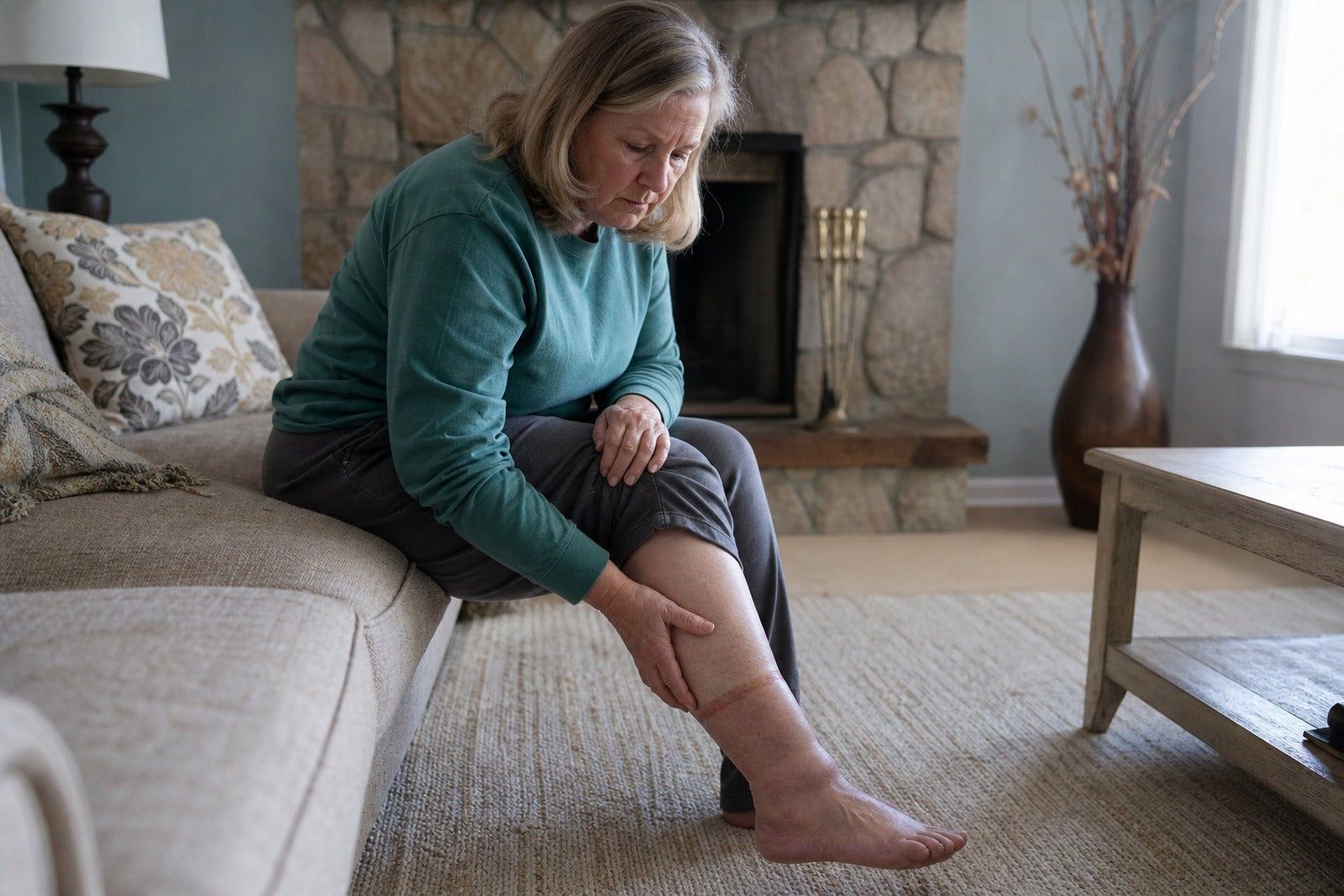
Your legs are fine at breakfast. By four in the afternoon your ankles have disappeared.
Your shoes are tight. Your legs feel heavy, like you are wading. And when you peel your socks off at night, there is a deep ring pressed into each leg that takes an hour to fade.
You did what you were told.
You cut the salt. You drank more water. You put your feet up on two pillows every evening. You gave up the shoes you liked and bought the wide ones.
And the next afternoon, your ankles were swollen again.
That is not a failure of effort.
It is what happens when the advice is aimed at the wrong thing.
Because in most people over 50, ankles that swell by the afternoon have very little to do with salt, and nothing to do with "just getting older".
The cause has a name. It sits inside the veins of your lower legs. It can be seen on an ultrasound in about ten minutes. And in 26 years as a vascular nurse, I watched it get waved away as "a bit of fluid" almost every single time.
I'll show you exactly what it is in a moment.
But first, there is something you need to stop doing.
STOP BLAMING THE SALT

If anyone has told you to cut the salt, drink more water, or "keep your feet up", I want you to notice one thing before you read any further.
Your swelling keeps a schedule.
It is gone in the morning. It builds through the day. It is worst in the evening. It is worse after a long drive, a flight, or a day on your feet in the kitchen. And it is always lowest down: the ankles first, then the tops of the feet, then the shins.
Salt does not behave like that. Salt would puff your hands and your face too, at any hour.
Swelling that starts at the ankle and gets worse the longer you are upright has one explanation: something in your legs has stopped moving blood up.
That is also why putting your feet up works, and why it stops working the moment you stand. You were letting the blood drain downhill toward your heart for an hour. Then you stood up, and it came straight back.
Nobody told you what was letting it come back.
That changes right now.

My name is Diane Mercer, RN. I was a vascular nurse for 26 years. I have measured and fitted thousands of legs for compression stockings. And at 58, with my own ankles swelling over my shoes, I found out why most of my patients had quietly stopped wearing theirs.
THE MORNING I COULD NOT DO MY OWN JOB

For most of my career I worked in a vein clinic. My job, a dozen times a day, was to measure a patient's ankle and calf, hand over a pair of compression stockings and say the same sentence:
"Put them on first thing, before you get out of bed, and wear them all day."
Then the patient would come back three months later, ankles the same, and tell me the stockings were "in the drawer".
I am ashamed to say I used to write non-compliant in the chart.
Then it happened to me.
At 58 my own ankles started to go. By the end of a shift there was a ridge of flesh over the top of each shoe. I knew exactly what it was, so I did what I had told everyone else to do. I took a pair home.
The next morning I sat on the edge of my bed and tried to put them on.
I had arthritis starting in both thumbs by then. I could not grip the fabric hard enough to stretch it. I got the foot in, and then the stocking jammed at my heel, bunched into a hard roll and would not move. I pulled until my thumbs burned. I tried the rubber gloves. I tried lying on my back with my leg in the air.
Twelve minutes for the first leg. I was sweating, and I was late for work.
I wore them for four days. Then they went in the drawer.
That is when I understood what "non-compliant" actually meant.
My patients had not been lazy. They had been physically unable to do the thing I prescribed, and too polite to say so.
WHAT IS ACTUALLY HAPPENING INSIDE YOUR LEGS

Here is the part that almost nobody explains, and it takes two minutes.
The blood in your feet has to travel about four feet straight up to get back to your heart. Standing or sitting, that is uphill the whole way.
Two things get it there.
The first is your calf muscle. Every time you take a step, the calf tightens and squeezes the deep veins that run through it. That squeeze pushes the blood upward.
The second is a row of valves. Inside each leg vein there are small flaps, every inch or two. They open to let blood pass upward, then close so it cannot fall back down between steps.
When those valves are working, your ankles look the same at 6 pm as they did at 6 am.
When they are not, this is what happens:
The flaps stop meeting in the middle. Blood that was just pushed up slides back down through the gap. It collects in the lowest part of the vein, at the ankle. The pressure inside that vein climbs through the day. And when the pressure gets high enough, the watery part of the blood is pressed out through the vein wall into the tissue around it.
That fluid in the tissue is the swelling you can see.
I call it Valve Leak.
Doctors call it chronic venous insufficiency, and it is far more common than most people realise once you are past 50.
It explains every part of your day. Fine in the morning, because you have been lying flat and the blood drained on its own. Worse by the afternoon, because you have been upright for eight hours. The deep ring from your sock, because the tissue under it is full of fluid and holds the dent. The heavy, tired, aching feeling, because the veins are stretched full.
None of that is salt. All of it is blood falling back down a vein whose valves no longer close.
WHY IT SHOWS UP AFTER 50

Vein valves are thin. Decades of standing, pregnancies, extra weight and plain years stretch the vein wall, and once the wall is wider, the flaps no longer reach each other.
At the same time, most of us walk less than we did, so the calf squeezes the veins less often.
Weaker valves. Fewer squeezes. More hours sitting with the knees bent.
Here is why the usual advice fails:
- Cutting salt does not close a valve. The fluid is being pushed out by pressure, not pulled in by sodium.
- Feet up works only while they are up. Stand, and the blood falls back within minutes.
- Water pills empty your bladder, not your ankle veins. Many people take them for years with the same ankles.
Nothing on that list does the one thing the valves used to do: hold the vein narrow enough that the blood keeps moving up.
But something does. Vascular clinics have used it for more than seventy years. It is the first thing every guideline recommends.
And it is the thing sitting in your drawer.
THE FIX EVERY DOCTOR RECOMMENDS, AND ALMOST NOBODY WEARS

Compression.
A firm, snug knit around the lower leg presses the vein from the outside. A narrower vein lets the valve flaps meet again. Blood that is pushed up stays up. The pressure at the ankle stops climbing through the day, so less fluid is pressed out into the tissue.
It is simple, it is drug-free, and it has to be on your leg to do anything.
That last part is the whole problem.
When researchers follow people who were prescribed compression stockings, they find the same thing I found in my own clinic: more than half have stopped wearing them within months. And the reason they give, far ahead of heat or itching or looks, is that they cannot get them on.
Think about what a compression stocking asks of you. It is a tube made deliberately too small for your leg. You have to grip it, stretch it open, and haul the tightest part over the widest part of your foot, bent double, first thing in the morning, with the hands and hips you have at 65.
For a stocking to help, it has to do THREE things:
REACH THE ANKLE: snug right down at the ankle bone, where the blood collects. A loose "support sock" that is tight only at the cuff does the opposite of what you need.
STAY ON ALL DAY: from before you stand up until you sit down for the evening, without rolling or sliding.
ACTUALLY GO ON: every single morning, with your own hands, in under a minute.
Miss any ONE of those and you are wasting your money.
The stockings in your drawer pass the first two.
They fail the third. So they are in the drawer.
The compression was never the problem. Getting it over your heel was.
So we took that step away.
INTRODUCING ZIPVERA ZIP-UP COMPRESSION SOCKS

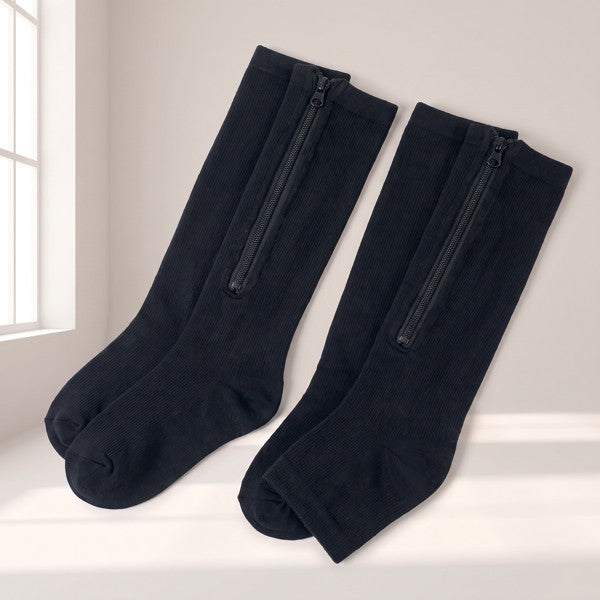
Zipvera is a knee-high compression sock with one difference that changes everything: a zipper runs down the side of the calf, from the cuff to just above the ankle bone.
Unzipped, the sock opens wide. Your foot slides in. Your heel passes without a fight. Then you zip it up, and the knit closes snug around your ankle and calf.
✓ FULL-LENGTH SIDE ZIPPER: no gripping, no hauling, no rubber gloves, no metal frame. If you can pull up the zipper on a jacket, you can put these on.
✓ SOFT FLAP BEHIND THE ZIPPER: a strip of fabric sits between the zipper and your leg from top to bottom, so the teeth never touch your skin.
✓ SNUG FROM ANKLE TO JUST BELOW THE KNEE: a fine rib knit that holds the lower leg firmly all day, with a closed toe and a reinforced heel.
✓ FOUR SIZES, UP TO 3XL: sized by your ankle and calf, for calves from 9 to 15.3 inches. Legs that have never fitted a pharmacy stocking fit these.
✓ BLACK OR BEIGE: under trousers they look like dress socks. Under a skirt the beige disappears.
You sit on the edge of the bed. You step in. You zip up. You get on with your day.
No appointments.
No fitting fee.
No twelve-minute wrestling match before breakfast.
No stockings in the drawer.
WHAT PEOPLE NOTICE

When you can put compression on in under a minute, you wear it. And when you wear it every day, here is what people describe.
The first morning: they are on before the coffee. Most people time themselves, because they do not believe it. Under a minute for both legs is normal.
The first evening: the ring is shallower. Many people check their ankles at the time of day they are usually at their worst and find their shoes still fit.
The first weeks: the heaviness lifts. Legs that are held snug all day feel lighter by the evening. People tell us they have stopped planning their afternoons around sitting down.
After that? They become part of getting dressed, like any other pair of socks.
Individual experience varies, and the people below are describing theirs.
WHAT PEOPLE ARE SAYING


"I'm 71 with arthritis in both hands. I have three pairs of prescription stockings I could never get past my heel. I zipped these on by myself the first morning and sat on the bed and laughed. My ankles at 5 o'clock are the proof."
"My husband used to have to put my stockings on for me, which neither of us enjoyed. Now I do it myself before he is out of the shower. The beige ones do not show under my church dresses."
"68, new hip, cannot bend past ninety degrees. The 3XL fits my calves, which nothing from the pharmacy ever did. I wear them on the drive to my daughter's, four hours each way, and my shoes still go on at the other end."
"Retired after 30 years on my feet in a hair salon. The explanation about the valves made more sense than 'watch your salt' ever did. I bought two pairs and went back for four more."
WHAT THE DRAWER HAS ALREADY COST YOU

Let me show you what the usual route costs, because I sold it to people for 26 years.
The Prescription Stocking Route:
- Medical-grade stockings: $60 to $120 a pair
- You need at least two pairs, and they are replaced every six months
- Total: $240 to $480 a year, for stockings most people stop wearing
The Gadget Route:
- A metal donning frame: $40 to $70
- Rubber gloves, slip sleeves, "easy-on" sprays
- All of it built to get you through a step that a zipper removes
The Do-Nothing Route:
- Wider shoes every couple of years
- Skin on the shins that gets tight, shiny and itchy
- Afternoons planned around where you can sit down
I am not telling you your doctor was wrong. Your doctor was right about compression. Nobody checked whether you could put it on.
The regular price for two pairs of Zipvera is $120.
But that is not what you will pay today.
WHY WE SEND TWO PAIRS, AND CHARGE FOR ONE
Compression only helps on the days you wear it. And you cannot wear a pair that is in the wash.
In the clinic I told every patient the same thing: you need two pairs, one on your legs and one drying. Most bought one, because of the price, and then skipped every second day.
So every order on this page is at least two pairs. Buy one pair, and the second pair is free.
Today that is $60 for two pairs. $30 a pair.
- Less than ONE pair of prescription stockings.
- Less than the donning frame built to get them on.
- Less than the wide shoes you bought because of your ankles.
For compression you will actually put on tomorrow morning.
LOOK, I UNDERSTAND THE SKEPTICISM
You have been down this road. You have a drawer of stockings that were supposed to help. You have been told "it's just fluid" by people with diplomas on the wall.
So here is my promise, and it is the only promise on this page:
Wear them for 90 days. If you are not glad you bought them, email us and we refund every penny.
- No forms.
- No "store credit".
- No questions you do not want to answer.
You keep the socks.
Why am I comfortable making that offer? Because compression is not in dispute. It is the first thing every vein guideline recommends. All we changed is the part that stopped you wearing it.
Support: support@zipvera.com
BUT HERE'S THE CATCH
The buy-one-get-one pricing on this page is for readers of this article, and we review it every week based on stock.
Our current batch is 3,000 pairs across four sizes and two colours. The larger sizes go first, because they are the ones nobody else makes.
We do not sell on Amazon. The zip socks you find there are mostly thin tubes with a zipper sewn straight against the skin and no flap behind it. A zipper that scratches your shin for ten hours goes in the same drawer as the stockings.
If you are reading this, the two-pair pricing is still available.
I cannot promise your size will be tomorrow.
And here is the thing...
Every day you wait is another day:
- Your veins fill and stretch a little further by the afternoon
- The fluid sits in the tissue around your ankles until bedtime
- You choose your shoes by what still fits at 4 pm
While the thing your doctor already told you to wear costs $60 for two pairs and goes on in under a minute.
THE CHOICE THAT DECIDES WHAT YOUR ANKLES LOOK LIKE AT 4 PM
Right now, you are at a fork.
Path #1: Keep Blaming The Salt
Keep cutting the salt, propping up your feet and buying wider shoes. Keep the stockings in the drawer. Keep hearing "it's just a bit of fluid".
Path #2: Wear The Compression You Were Told To Wear
Spend less than one pair of prescription stockings on two pairs you can zip on yourself, wear them for a week, and look at your ankles at the time of day they are usually at their worst.
The choice seems pretty obvious to me.
HERE'S EXACTLY WHAT TO DO NEXT
- 1. Click the button below that says "Check Availability Now →"
- 2. Choose your pack, your size and your colour. (Measure around your ankle and the widest part of your calf. The chart is on the next page.)
- 3. Fill in your shipping details. Orders ship from our US warehouse within one business day.
- 4. When they arrive, unzip one all the way, slide your foot in, and zip up.
- 5. Look at your ankles at 4 pm. Then email us and tell us what you saw. We read every one.
But whatever you do, don't close this page thinking "I'll order later."
Later is another afternoon of tight shoes.
Later is another evening with your feet on two pillows.
Later is your size being out of stock.
Your doctor was right about compression. You just needed a way to get it on.
Click below and zip up.
READER OFFER
FOR A LIMITED TIME:
BUY ONE PAIR, GET ONE PAIR FREE + FREE US SHIPPING
LIMITED TIME READER-ONLY SPECIAL:
Ordering from this page gets you two pairs for $60, free US shipping, and the 90-day money-back promise above.
With respect, and a zipper on each leg,
Diane Mercer, RN
Vascular Nurse (retired), Zipvera
P.S. I timed myself this morning. Forty seconds, both legs, thumbs and all.
P.P.S. If your ankles are fine at breakfast and swollen by the afternoon, press a thumb into the skin just above your ankle bone this evening and hold it for five seconds. If it leaves a dent that stays, that is fluid pressed out of the vein, and you already know what your legs are asking for.
P.P.P.S. The two-pair pricing is reviewed weekly against stock. The button below is the only place it exists.